
GST Registration Online in Delhi – Complete Guide 2026
All you need to know about GST registration Online in Delhi for first-time entrepreneurs – right from qualification criteria, documentation, timelines to penalties and compliance best practices.
What Is GST and Why Does Registration Matter?
Starting a business in India is really exciting. There is a lot to do before you can begin. One of the important things is getting GST registration. This can seem scary if you are new to business. It is a key part of being in business in India. Getting a GST registration Online is really important for any business that wants to follow the law and get tax benefits. If you have a business or work on your own or if you have a company getting a GST number is a good idea. It helps people trust your business. Makes it easy to do business anywhere in India. GST registration is necessary for all kinds of businesses in Delhi like startups and private limited companies because it helps them grow and do well. GST registration, in Delhi is something every business should consider because it helps them work smoothly and get all the benefits they are supposed to get.
GST is a type of tax on goods and services. It was introduced in July 2017. Replaced many other taxes. Almost all businesses in India have to follow the GST rules.
- GST is a tax that applies to goods and services across India.
- It replaced other taxes like central excise duty and service tax.
To get GST registration you need to enroll your business under the GST law. When you do you will get a 15-digit Goods and Services Tax Identification Number, also called GSTIN.
This GSTIN is very important. It is like your tax identity. You will use it on every invoice you create every tax return you file and every refund you claim.
The law for GST is controlled by the Central GST Act, State GST Acts and the IGST Act.
Getting a GST registration is helpful because it lets the government keep track of the taxes and it makes doing business in India easier for businesses like the business you want to start in India. The GST registration is very useful for the business in India because it helps the government and the business, in India. Getting GST registration is a step for any business, in India.
GST Registration Online
GST registration online is a way for businesses to get a GSTIN. They can do this through the GST portal. This means they do not have to go to any government office. The whole process of getting registered is done online. This makes it easy for businesses to get registered. It is also very clear and simple. All types of businesses in India can get registered online. Online GST registration in Delhi is really helpful for people who want to start their business, like entrepreneurs, startups and even big companies. They can get their GSTIN without having to go to any government office. Everything is done on the GST website, and it is very safe and honest.
Registering online is a big-time saver. It makes it easy for businesses to follow the rules and start working under the GST system. This way businesses can operate without any issues.
This is good for startups, freelancers, traders and companies. GST registration online helps businesses follow the law. It also helps them run their business smoothly. GST registration online is very helpful for businesses, like yours. You can get a GSTIN. Start your business easily.
Why Registration Is a Must?
Getting a GST registration in Delhi or any other state is really good for businesses. They can get Input Tax Credit and people will think their business is more credible. They can also do business with states.
It helps businesses follow the law. It is good for them, in the long run. It helps them grow and expand their business. Registered businesses can take part in government tenders. Sell things on big e-commerce platforms like Amazon, Flipkart, etc.
- It’s the law: If your business is big enough you have to register. It’s not optional.
- Get tax benefits: Only registered businesses can get Input Tax Credit. This helps avoid taxation.
- Build trust: Big buyers, online marketplaces and government contracts want to see a GST number.
- Sell anywhere: You can’t sell to people in states without registration no matter how much you sell.
- Watch out for fines: If you don’t register when you should you’ll pay a penalty of 10% of the tax you owe (at Rs. 10,000). It can be even worse if you’re caught doing something you’ll pay 100% of the tax.
Who Is Required to Register? Understanding Thresholds
Eligibility for GST registration in Delhi depends on things like how money your business makes in a year what kind of business you do and whether you sell to other states or online. Some businesses have to register for GST not how much money they make.
Knowing the rules, for GST eligibility helps businesses figure out if they need to register and avoid getting fined for not following the rules. Not every business needs to register for GST. The law says that small businesses with turnoverdo not need to register. Some types of businesses have to register no matter how much money they make.
- Several categories of businesses must register for GST regardless of their turnover.
- The law provides exemptions for enterprises based on their turnover.
However if your business falls into one of these categories you will have to register for GST.
Some examples of businesses that must register for GST include:
- Businesses that sell or provide supplies.
2. Businesses, with a turnover.
3. Businesses that import or export goods also have to register.
GST Turnover Thresholds
| Category | Threshold (Annual Turnover) |
| Service providers (special category states) | Rs. 10 lakh |
| Service providers (all states) | Rs. 20 lakh |
| Goods suppliers (special category states) | Rs. 20 lakh |
| Goods suppliers (most states) | Rs. 40 lakh |
| Composition Scheme eligibility (goods) | Up to Rs. 1.5 crore |
| Special category states include Manipur, Mizoram, Nagaland, Tripura, and others notified under the GST Act. |
Mandatory Registration Regardless of Turnover
Mandatory registrations are required for businesses. There is no limit on the amount of turnover for these registrations.
- Businesses that sell goods or services to people in states
- People who sell things online on websites like Amazon, Flipkart and Meesho
- Businesses that sell goods in a state where they do not have a store or office
- Businesses that are not from the state but still have to pay tax
- Businesses that pay tax under the reverse charge system
- Businesses that help other companies manage their taxes
- Agents who help registered businesses sell goods or services
- People who have to take out tax when they pay for something, under the Goods and Services Tax system
| “Voluntary GST registration — even below the threshold — can be a smart business decision if it opens doors to B2B clients who require a GSTIN.” |
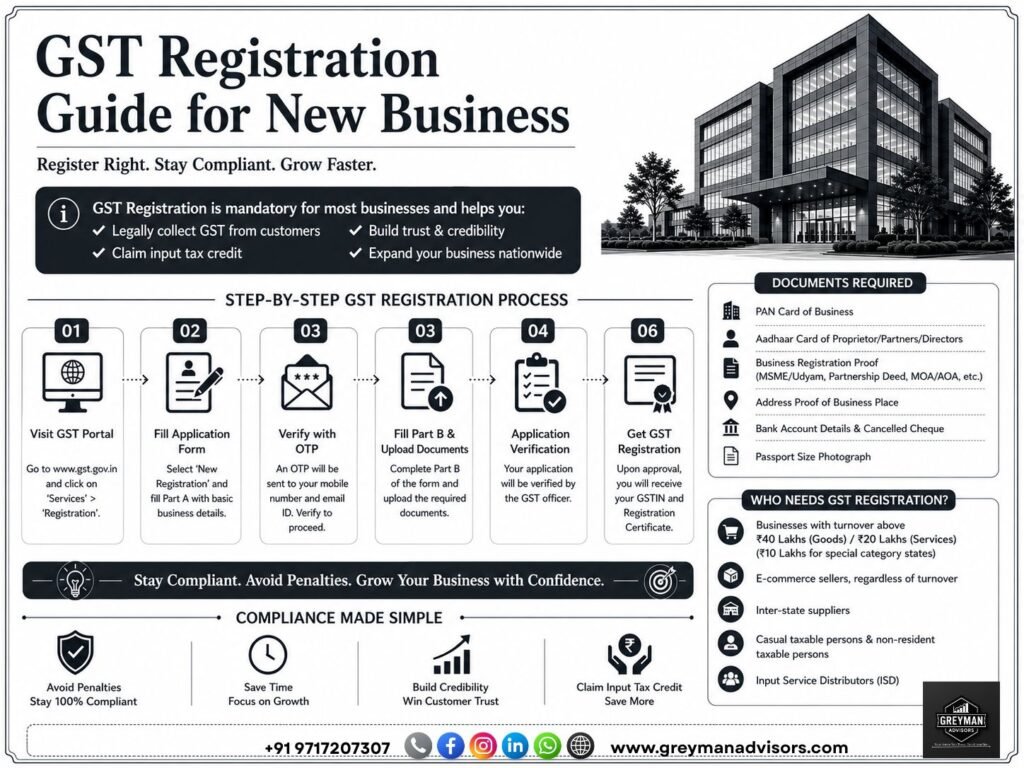
Documents Required for GST Registration
The GST registration documents required in Delhi are different based on what kind of business you have, like if you’re the owner, a partnership, an LLP or a company. You usually need things like your PAN, Aadhaar, something to prove your address your bank information and papers that say how your business is set up.
It is an idea to make sure all your documents are up to date and look right because this helps you get approved faster for GST registration, in Delhi. If your GST registration documents are not correct you might not get approved so keeping everything helps a lot with the GST registration process.
To register for GST you will need some documents. These include your PAN card, your Aadhaar card and proof of where your business is. You will also need your bank account details, some photographs and other documents that are specific to your business. For example if you have a partnership you will need a partnership deed. If you have a liability partnership you will need an LLP agreement. If you have a company you will need a Certificate of Incorporation.
These GST registration documents are necessary, for GST. You have to provide these GST registration documents to complete the GST registration process.
Before you start filling out the GST application you need to get all your documents in order. This depends on the type of business you have. If your GST application is not complete it will probably be rejected. This is one of the reasons why GST registrations get held up. You need to make sure you have all the GST registration documents ready.
For Sole Proprietorship / Individual
DOCUMENTS CHECKLIST
- PAN card of the proprietor
- Aadhaar card of the proprietor
- Photograph (JPEG, max 100 KB)
- Proof of business address (electricity bill / rent agreement / NOC from owner)
- Bank account details — cancelled cheque or bank statement (first page)
For Partnership Firms / LLPs
DOCUMENTS CHECKLIST
- PAN of the firm
- Partnership deed / LLP agreement
- PAN and Aadhaar of all partners / designated partners
- Photographs of all partners
- Proof of principal place of business
- Bank account details of the firm
- LLP registration certificate (for LLPs)
For Private Limited / Public Limited Companies
DOCUMENTS CHECKLIST
- PAN of the company
- Certificate of Incorporation from MCA
- Memorandum and Articles of Association (MoA & AoA)
- PAN and Aadhaar of all directors
- Board resolution authorising the signatory
- Proof of registered office address
- Bank account details
- Digital Signature Certificate (DSC) of authorised signatory
Step-by-Step GST Registration Process
The GST registration process time is usually, between 3 and 7 working days when you do the Aadhaar authentication.
If the people who are processing your application need to check some things in person, it can take up to 30 days to get your GST registration. So, it is an idea to make sure all the documents are correct. This can really help cut down on delays with the GST registration process.
The time it takes to get a GST registration in Delhi is usually between 3 to 7 working days. This is when the Aadhaar authentication is done successfully. If the GST officer needs to verify things it can take longer.
To get the GST registration quickly businesses should give the documents. They should also respond quickly when they get a notice from the GST office. This way businesses can get their GST registration without waiting long. The GST registration process is important, for businesses so they should make sure to do everything to get their GST registration.
The GST registration process can be quick if everything is in order. The registration process is entirely online through the GST Portal (www.gst.gov.in). Here is how it works:
- Generate a Temporary Reference Number (TRN)
To start you need to go to the gst.gov.in website. Then you must click on Services and then Registration and then New Registration. You will have to enter your PAN number, your number and your email ID on the gst.gov.in website. You will get OTPs on your mobile and your email so you must verify these OTPs that you got on your mobile and your email to get a TRN on the gst.gov.in website. This TRN will be valid for fifteen days, on the gst.gov.in website.
- Fill Form GST REG-01 (Part B)
Log in using the TRN. Fill in your business details: legal name, trade name, business constitution, principal place of business, additional places (if any), nature of business, HSN/SAC codes, and bank details.
- Upload Supporting Documents
Attach all required documents in the prescribed format (PDF or JPEG, size limits apply). Ensure scans are legible — blurry or cropped documents are a common cause of rejection.
- Submit with DSC / EVC / Aadhaar OTP
Companies and LLPs must submit using a valid DSC. Proprietorships and partnerships can use Electronic Verification Code (EVC) or Aadhaar-based OTP. You receive an Application Reference Number (ARN) on submission.
- GST Officer Review
The assigned GST officer reviews your application within 7 working days. If satisfied, they approve it. If clarification is needed, they issue Form GST REG-03 — you have 7 working days to respond via GST REG-04.
- Receive Your GSTIN and Registration Certificate
Upon approval, your GSTIN is issued in Form GST REG-06. Download and display your registration certificate prominently at your place of business — it is a legal requirement.
| IMPORTANT TIMELINE NOTE If Aadhaar authentication is completed, registration is typically granted within 3 working days. Without Aadhaar authentication, the application is forwarded for physical verification, which may take up to 30 days. |
New GST Registration Fees
There is no fee from the government to get a GST registration in India. You can do it for free on the GST portal. Some people help businesses with GST registration. They may charge a fee, for their services like preparing papers filling out forms and making sure everything is done correctly according to the rules.
GST registration is free.
New GST Registration Fees in Delhi
The new GST registration fees in Delhi are the same as they’re in the rest of India. There are no government charges that you have to pay when you register for GST.
If you are a business looking for New GST Registration Online in Delhi you should know that the government does not charge you any fee to register. You will have to pay some money to the people who help you with the paperwork and filling out the application.
If you need help with GST registration you can hire a GST consultant or a Chartered Accountant. The thing is, you will have to pay them for their services. The amount you pay them will depend on how complicated your GST registration is and what documents you need to submit. This means GST registration fees for businesses will be different because the work involved is different, for each business.
Composition Scheme: A Simpler Option for Small Businesses
If your total yearly turnover is less than Rs. 1.5 Crore you can choose the Composition Scheme. This scheme is a way to follow GST rules. You pay GST at a fixed rate on your turnover. You also file returns every three months, not every month. The turnover limit is Rs. 75 Lakh, for some category states.
| Business Type | Composition Rate |
| Manufacturers (excluding tobacco, pan masala, ice cream) | 1% of turnover |
| Traders (goods) | 1% of turnover |
| Restaurants (not serving alcohol) | 5% of turnover |
| Service providers (CGST Notification) | 6% of turnover |
| COMPOSITION SCHEME RESTRICTIONS Composition dealers cannot make interstate supplies, cannot claim Input Tax Credit, cannot supply exempt goods, and cannot issue tax invoices. They must issue a ‘Bill of Supply’ instead. Carefully evaluate whether the scheme suits your business model before opting in. |
After Registration: Key Compliance Obligations
Receiving your GSTIN is not the finish line — it is the starting line. Here is what your ongoing compliance calendar looks like:
GST Return Filing
| Return | Who Files | Frequency | Due Date |
| GSTR-1 | Regular taxpayers (outward supplies) | Monthly / Quarterly | 11th / 13th of next period |
| GSTR-3B | Regular taxpayers (summary + payment) | Monthly | 20th of next month |
| GSTR-4 | Composition dealers | Annual | 30th April of next FY |
| GSTR-9 | Regular taxpayers (annual return) | Annual | 31st December of next FY |
| GSTR-9C | Taxpayers with turnover > Rs. 5 crore | Annual (with audit) | 31st December of next FY |
Invoicing Rules
When you make a tax invoice you have to put your GSTIN on it and the buyers GSTIN if you are selling to a business. You also have to put the invoice number and the date you made it. Then you have to add the HSN or SAC codes the value, the GST rate that applies and the amount of GST you have to pay. This includes the Central GST and State GST if you are selling in the state or the Integrated GST if you are selling in a different state. You have to say where the supply is happening, which is the place of supply, for the tax invoice.
E-Invoicing
Companies that make more than Rs. 5 Crore in a year have to make invoices. They do this through the Invoice Registration Portal. The Invoice Registration Portal gives each invoice a number called the Invoice Reference Number and a QR code. The Invoice Reference Number is unique. So is the QR code. This is how the Invoice Registration Portal keeps track of all the invoices. Businesses use the Invoice Registration Portal to get the Invoice Reference Number and the QR code, for each invoice they make.
E-Way Bills
When we talk about the movement of goods that’re worth more than Rs. 50,000 In a single consignment we need to get a valid E-Way Bill. This E-Way Bill has to be generated on the e-way bill portal. We must do this before the goods start moving from one place to another. The E-Way Bill is important for the movement of these goods.
Penalties for Non-Compliance
The GST law takes non-compliance seriously. Here is a snapshot of the consequences:
PENALTY SUMMARY
- If you do not register, you must pay a penalty. This penalty is 10 percent of the tax that you must pay. The minimum penalty is Rs. 10,000.
- If you do not register on purpose, which is called non-registration, you must pay a big penalty. This penalty is equal to the tax that you were trying to avoid.
- If you file your return late you must pay a fee. This late fee is Rs. 50 Per day. However, if you do not have any tax to pay the late fee is Rs. 20 Per day. You do not have to pay more than Rs. 5,000 For one return.
- If you pay your tax late you must pay interest. This interest is 18 percent per year. You must pay interest in the tax that you still have to pay.
- If your invoices are not correct you have to pay a penalty. The penalty for invoicing is Rs. 25,000 Per invoice. However, if the tax amount is lower you only have to pay the tax amount.
Voluntary Registration: When It Makes Business Sense
If your turnover is below the threshold, you are not obligated — but you may still benefit from voluntary GST registration. Consider it when:
REASONS TO VOLUNTARILY REGISTER
- B2B clientele: Registered businesses can only claim ITC from other registered suppliers — corporate clients prefer registered vendors.
- E-commerce selling: Most major platforms require GSTIN to onboard sellers, even below the threshold.
- Credibility: A GSTIN signals seriousness and formal structure to potential partners.
- Futureproofing: Proactive registration avoids a scramble when you cross the threshold organically.
- ITC benefit: If you have significant purchases with GST, voluntary registration lets you reclaim that credit.
Practical Tips for a Smooth Registration Experience
PRO TIPS FROM GREYMAN ADVISORS
- Link Aadhaar early. Ensure your mobile number is linked to Aadhaar before you start.
- Use business email and phone. These are your primary channels with the GST department.
- Match your name exactly. The name on your PAN must exactly match your GST application.
- Verify bank details twice. An incorrect IFSC or account number will cause refunds to fail.
- Keep the ARN safe. Your Application Reference Number lets you track your application at any time.
- Respond promptly to REG-03. You have 7 working days — delay means starting over.
Getting a GST registration is not something you have to do by law. It is an important part of your businesses money matters. If you do it correctly it helps you get money back, get clients to grow your business in many states and run your business in a very open and honest way with full confidence. GST registration helps your business in ways like claiming credits and operating with full transparency and confidence and that is why GST registration is very important for your business.
If you are looking for GST Registration Online Near Me you can get help from GST consultants who’re professionals. They can help you with preparing the documents, filing the application and keeping track of the registration from any place in Delhi.
Getting help from experts is an idea because it helps you avoid making mistakes. It also helps to reduce the time it takes to process your application and makes sure you are following all the GST rules that’re in place right now. GST Registration Near Me is something that these professionals can help you with.
Need Help with GST Registration?
Let our expertsat Greyman Advisors handle it — accurately, quickly, and without the paperwork headache.
Frequently Asked Questions (FAQs)
How do I apply for GST registration online?
You can do this by going to the GST portal and creating a TRN. Then you have to fill out Form GST REG-01 and upload some documents. After that you need to complete the verification process.
What documents do I need for GST registration?
For GST registration you need some documents like your PAN card, Aadhaar card, address proof, bank account details, photographs and some other documents that are specific to your business.
How long does it take to get GST registration?
It usually takes between 3 and 7 working days to get GST registration if you use Aadhaar authentication. Sometimes it can take up to 30 days.
Do all businesses need to get GST registration?
No not all businesses need GST registration. You only need it if your business crosses a threshold or if it falls under some special categories that need registration.
What are the fees for GST registration?
There are no fees from the government for GST registration in India. You might have to pay some money to a professional who helps you with the registration.
What about the fees for GST registration in Delhi?
There are no government fees for GST registration in Delhi either. You will only have to pay for help if you need it.
Can I get GST registration even if I do not need it?
Yes you can get GST registration voluntarily even if your business is below the threshold. This can help you get some benefits like ITC. It can also make your business look more credible.
What if I do not get GST registration when I am supposed to?
If you do not get GST registration when you are required to you might have to pay some penalties and interest. You could also face some problems with the law.
Can I apply for GST registration without a bank account, for my business?
You usually need a bank account to apply for GST registration. This is because it makes it easier to comply with the rules and to get your refunds.
How can I check the status of my GST registration application?
You can track your application on the GST portal using the ARN that you got after you submitted your application.